German Protests Against AfD Put Political Risk Back on Household Radar
Mass demonstrations across Germany highlighted how political polarization can shape confidence, savings decisions, and currency risk.
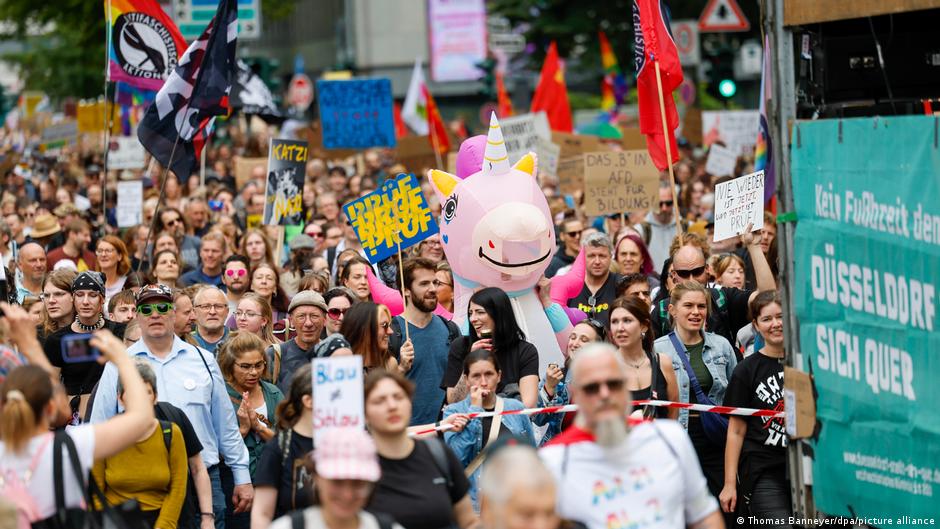
Mass demonstrations against right-wing extremism took place in more than 35 German cities on Saturday, September 12, placing the country’s political tensions back in focus for households, savers and everyday investors watching Europe’s largest economy.
The protests came one week after the far-right Alternative for Germany, or AfD, won a state election in Saxony-Anhalt. For consumers and investors, the significance goes beyond party politics. Germany remains a key anchor for the eurozone, and sustained political uncertainty can affect confidence, public spending debates, labor-market expectations and the way households think about savings, mortgages and currency exposure.
Turnout was substantial in several major cities. In Hamburg, organizers estimated that 25,000 people joined the demonstration. In Düsseldorf, about 20,000 took part, a figure also confirmed by local police. In Berlin, police estimated turnout at 18,000, while public broadcaster ARD estimated that 12,000 people demonstrated in Munich. Around 2,000 people protested in Mainz.
Smaller demonstrations were also held in state capitals and regional cities. In Magdeburg, the capital of Saxony-Anhalt, around 1,100 people joined the protest. Saarbrücken drew about 1,500 participants, Erfurt saw several hundred, and Schwerin, the capital of Mecklenburg-Western Pomerania, drew several dozen people. In Mecklenburg-Western Pomerania, where local elections were due a week later, polls also showed the AfD in the lead.
Why Political Risk Matters for Family Finances
For German households, political instability can show up in practical ways before it appears in any single economic indicator. Consumer sentiment may weaken if families become less certain about job security, tax policy, social benefits or the direction of public investment. That can influence whether people make large purchases, increase precautionary savings or delay decisions such as buying property, refinancing debt or investing in pension products.
The demonstrations were organized by more than 100 groups and reflected a wider debate about whether existing democratic and legal safeguards are strong enough to address parties classified by authorities as suspected or confirmed right-wing extremist organizations. That debate matters to markets because confidence in institutions is part of the foundation on which households and investors make long-term plans.
Several demonstrations, including those in Munich, Mainz, Saarbrücken and Magdeburg, were held as part of the Prüf campaign. The campaign calls for a thorough examination of parties classified by Germany’s Federal Office for the Protection of the Constitution, known as the BfV, as either “suspected” of right-wing extremism or “definitely right-wing extremist.” The German word “Prüf” means “check,” and organizers present it as an abbreviation for Prüfung Rettet Übrigens Freiheit, meaning “checking, by the way, saves freedom.”
Protesters in Düsseldorf marched under the slogan “No step back! Against the AfD and right-wing incitement,” while demonstrators in Hamburg used the slogan “Time to act — freedom must be defended.”
At the center of the demonstrations were calls to initiate a procedure to ban the AfD. In May 2025, the BfV classified the party as right-wing extremist at the federal level. However, that classification is not currently in effect because of a lawsuit filed by the party.
For savers and retail investors, the question is not only whether the AfD faces legal consequences, but how the political dispute affects Germany’s policy outlook. A more fragmented political environment can complicate coalition-building, budget negotiations and the execution of long-term economic plans. That can feed into expectations for growth, public borrowing, business investment and, indirectly, the euro.
Markets Watch the Social Backdrop
Germany’s household finances are already tied closely to broader European conditions. The euro exchange rate affects imported goods, travel costs and the value of foreign investments held in brokerage accounts or retirement portfolios. German government bonds, bank deposits and euro-denominated funds all sit within a financial system where political confidence plays a role in risk pricing, even when day-to-day market moves are driven by interest rates and inflation data.
Large demonstrations do not automatically translate into market disruption. They can also signal civic mobilization and institutional resilience. But when protests occur after an electoral breakthrough by a polarizing party, investors tend to watch whether the political environment becomes more predictable or more fractured. That is especially relevant for families with exposure to European equity funds, euro savings, variable-rate debt or globally diversified portfolios whose returns move with currency changes.
The latest polling underscores the division. An INSA survey conducted on September 10 and 11 found that 42% of respondents supported the idea of banning the AfD, while 45% opposed it. The same survey found that almost half of Germans, 46%, opposed the “firewall” policy toward the AfD, under which other parties refuse to cooperate with it. Thirty-four percent supported maintaining the barrier, while 20% were undecided.
That split suggests political uncertainty is likely to remain part of the financial backdrop. For households, the immediate takeaway is not to make abrupt savings or investment decisions based on a single weekend of demonstrations. Rather, the protests are a reminder that political risk belongs on the same watchlist as inflation, interest rates and employment trends. In a country as economically central as Germany, shifts in voter sentiment, legal challenges involving major parties and public confidence in democratic institutions can all influence the environment in which families budget, save and invest.