Khodorkovsky Urges Europe to Offer Russian Elites a Path Away From Putin
The opposition figure argues that a managed political transition could reduce conflict risks affecting sanctions, currencies and household finances.
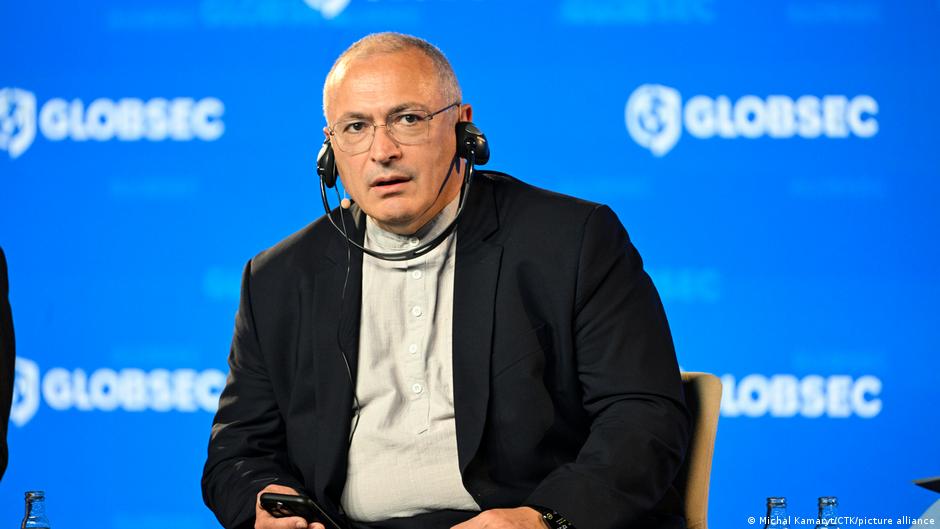
European governments should offer influential members of Russia’s elite a credible alternative to supporting President Vladimir Putin, according to opposition figure Mikhail Khodorkovsky, who argues that personal exit routes could encourage divisions within the leadership surrounding the Kremlin.
Speaking at a conference of the Russian Anti-War Committee in Brussels on Tuesday, Nov. 3, Khodorkovsky said powerful Russians remain aligned with Putin partly because they are not convinced that their circumstances would improve without him. He also pointed to the extensive personal security system constructed by the Russian president when asked whether domestic players could remove Putin from power.
For households and individual investors, the debate has consequences beyond Russian politics. Any shift in the country’s leadership could influence the duration of the war against Ukraine, the future of European sanctions and the outlook for trade and currencies. Those factors can flow through to energy bills, inflation, interest rates, savings returns and the value of investments exposed to Russia or the wider region. Khodorkovsky did not present a financial forecast or predict how markets would react.
“If we are talking about a split among the elites, then we need to demonstrate opportunities for a personal exit,” Khodorkovsky said.
Such an exit could still involve certain losses for the individuals concerned, he added. Khodorkovsky called Europe’s failure to provide opportunities of this kind by the fifth year of the war a serious mistake. He did not specify the terms of a possible arrangement at the conference.
In earlier writing, however, he argued that a simple declaration of disagreement would not be sufficient for people who had cooperated with the Russian system. He cited donations to Ukraine and testimony to investigators about crimes committed by the regime as examples of steps they could take.
Transition risks could reach household finances
Khodorkovsky also used his opening address to warn against approaches that could turn a future Russian political transition into another armed conflict. Attempts to prosecute people connected with the war or restrict their rights could provoke armed resistance within Russia, he said.
Millions of Russians have links to the war, according to Khodorkovsky. They may have fought themselves, have relatives who fought, worked at military enterprises or supported the political order established by the authorities. Some are accustomed to handling weapons and could resist measures directed against them, he warned.
“And we must understand that when we talk about lustration, contributions and trials of war criminals, we are talking about a new war,” he said.
For consumers, another conflict involving a major energy and commodity producer could prolong the uncertainty that already surrounds household budgets. Renewed instability could affect expectations for oil, gas and other traded goods, while political risk may contribute to volatility in the ruble and neighboring currencies. European savers and everyday investors could also face swings in funds holding energy companies, defense businesses, emerging-market assets or regional debt. These are potential channels of exposure rather than outcomes predicted by Khodorkovsky.
He contrasted efforts to force the desired transformation with a strategy of national reconciliation and gradual democratization. In his assessment, armed confrontation within Russia would produce a new authoritarian system and postpone the prospect of democratic change for another political generation.
Khodorkovsky issued a similar warning about the possible breakup of the Russian Federation, saying such an outcome would be paid for in blood. He urged policymakers to discuss not only the result they want but also the methods used to achieve it.
A proposed institutional route to lower risk
Instead, Khodorkovsky proposed focusing on what he called “institutional de-escalation”: reducing the threat of war by changing how power is organized in Russia. He argued that even a move from one-person rule to collective leadership could lower the probability of war. A parliamentary model and greater federalization would reduce that probability further, in his view.
From a personal-finance perspective, a transition that lowers geopolitical risk could eventually help stabilize expectations around sanctions, cross-border payments, energy supplies and regional currencies. That could matter to families managing heating and transport costs, migrants sending money across borders and investors assessing exposure to European or emerging markets. Yet the route described by Khodorkovsky remains a political proposal, and he offered no timetable, detailed implementation plan or assurances about sanctions relief.
The Russian Anti-War Committee’s two-day conference is taking place in Brussels on Nov. 3-4 and is focused on scenarios for ending Russia’s war against Ukraine. Its program also includes discussions about sanctions, nuclear risks and the possibility of putting Putin on trial. Those subjects carry distinct financial implications, but the conference is examining political scenarios rather than providing investment guidance.
For households, the central issue is therefore uncertainty. A split within Russia’s elite might open a route toward political change, while a violent or disorderly transition could introduce new risks. Khodorkovsky’s case is that European policy should create incentives for an exit from the current system while avoiding measures that could turn political change into another war.