White House Says U.S. Envoys Discussed Ukraine Peace Plans With Putin
The diplomatic push could matter for household budgets by shaping energy prices, currencies, defense spending and investor risk appetite.
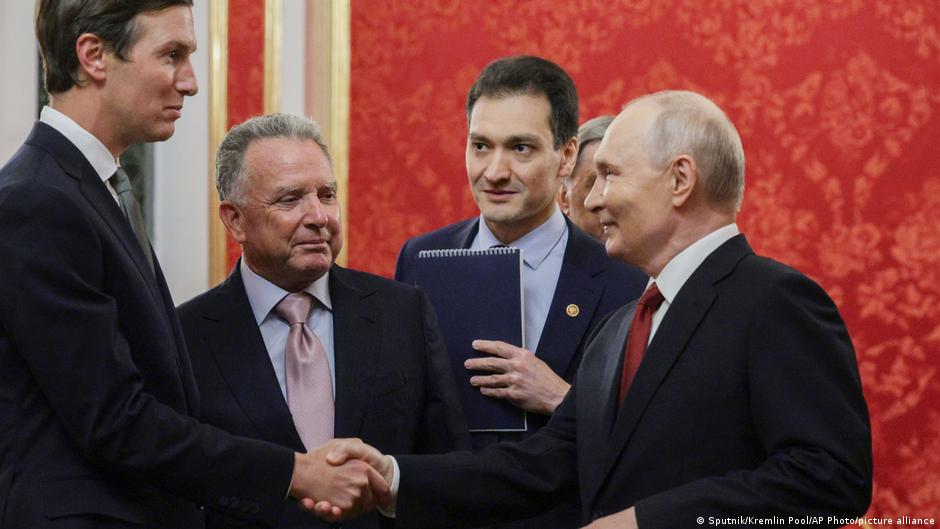
The White House says U.S. representatives Stephen Witkoff and Jared Kushner discussed “concrete plans” with Russian President Vladimir Putin on further steps aimed at ending the war in Ukraine, with those proposals expected to be made public “in the coming weeks.” For households and everyday investors, the talks are not only a geopolitical development. Any credible movement toward a ceasefire or settlement could influence energy costs, food prices, defense spending expectations, currency markets and broader risk sentiment.
A White House representative told AFP overnight into Sunday, September 6, that Witkoff, a special envoy of U.S. President Donald Trump, and Kushner, Trump’s son-in-law, had held talks in Moscow focused on “concrete plans” for next steps to stop the war. The U.S. side, according to the same account, now looks forward to “no less productive meetings” in Ukraine.
Trump also announced a new diplomatic initiative to end the war and said Witkoff and Kushner were carrying a plan “to end the war,” AFP reported. He did not specify whether the plan would include the transfer of Ukrainian territory to Russia, saying only: “We have an idea for peace.”
“We have an idea for peace.”
After the Moscow visit, Kushner and Witkoff are set to travel to Kyiv for their first talks there with Ukrainian President Volodymyr Zelensky. Data from Flightradar24 showed that the Boeing C-32A aircraft carrying the U.S. envoys landed at 01:30 local time at the airport in Rzeszow, Poland. The plane departed Moscow’s Vnukovo airport, headed west while avoiding Belarus, and crossed the airspace of Latvia, Lithuania and Poland. The envoys are expected to continue to the Ukrainian capital by train.
Why Peace Talks Matter for Household Finances
The immediate contents of the proposal remain undisclosed, but the financial implications of the war have long extended beyond the battlefield. The conflict has affected global energy flows, government budgets, inflation pressures and investor demand for safe-haven assets. For consumers, that can translate into changes in gasoline prices, heating bills, grocery costs and the purchasing power of savings.
A diplomatic process that appears more serious could ease some risk premiums in energy and commodity markets, though the source article does not provide market data or forecast any price moves. The practical point for households is that wars and sanctions can affect the prices of essentials indirectly, while the possibility of de-escalation can change expectations even before any final agreement is reached.
Currency markets are another channel. The war in Ukraine has remained a major factor in European security and in investor perceptions of political risk across the region. Developments that alter the outlook for the conflict can influence demand for dollars, euros and other currencies. For Americans with international travel plans, foreign holdings or retirement funds invested globally, shifts in currency and equity sentiment can affect real-world budgets and portfolio values.
Everyday investors may also watch defense, energy and infrastructure-related shares for signs of repricing if the diplomatic track develops. The article does not report any market reaction, and the details of the U.S. proposal are still unknown. That uncertainty matters: markets often respond not only to the possibility of peace, but to the terms, durability and enforcement of any arrangement.
Moscow and Kyiv Prepare for the Next Round
In Moscow, Russian officials described Putin’s talks with the U.S. delegation as “extremely frank.” Yuri Ushakov, an aide to the Russian president, said the U.S. delegation had presented “several ideas” on how the war in Ukraine could be brought to an end.
“The American representatives prepared carefully for this trip. They not only expressed interest in the quickest possible end to hostilities, but also presented several ideas about possible ways toward a solution,” Ushakov told Russian journalists.
Ushakov also described the talks as timely and useful for both sides. “In general, one can say that the negotiations were timely and very useful for both sides,” Interfax quoted him as saying. “Our president confirmed his intention to continue joint work with the Americans in search of political and diplomatic outcomes.”
RBC reported that the Russian side gave the Americans its assessments of the course of military operations in Ukraine, including what it described as successes by the Russian army and “confidence in achieving the set goals.” According to the agency, Trump’s envoys promised to use that information during the talks in Kyiv.
For Ukraine, the financial stakes are also immediate. The war has shaped state spending, reconstruction needs, external assistance and household resilience. A credible diplomatic opening could affect expectations for aid, borrowing, investment and rebuilding, but the unresolved questions around territory and security guarantees remain central to any durable economic outcome.
Zelensky held a phone call the previous day with the U.S. envoys after their arrival in Russia and announced readiness to halt strikes on Moscow for the next three days. “The plan of diplomatic measures for tomorrow in Kyiv with the participation of the American team has been approved. We are waiting for Steve Witkoff and Jared Kushner and are ready for a substantive conversation,” Zelensky said on social media.
For savers and investors, the key issue is whether these meetings produce verifiable next steps rather than broad statements of intent. The White House says concrete plans were discussed and that more productive meetings are expected in Ukraine. Moscow says several ideas were presented and that work with the Americans should continue. Kyiv says it is ready for a substantive conversation. Until the plan is published, the financial impact remains a question of expectations, but the talks place a major household-budget driver back at the center of diplomatic attention.