Italy Cost-of-Living Protests Put Household Finances in Focus
Demonstrations over fuel prices, living costs and government policy continued as Italian police reported hundreds of detentions.
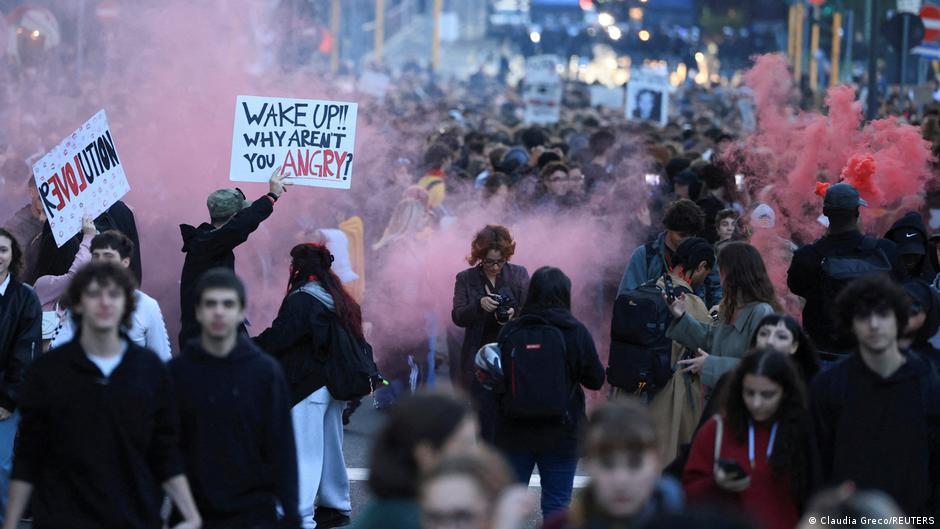
Protests over Italy’s high cost of living continued on Saturday, October 24, bringing household financial pressures back into public view as demonstrators also opposed rising fuel prices, increased military spending and the policies of Prime Minister Giorgia Meloni’s government.
Police reported nine arrests and 371 preliminary detentions, including 110 cases involving minors, according to AFP. The figures followed demonstrations on October 17 and 18 that descended into disorder and prompted the authorities to strengthen security measures.
For Italian households, the demonstrations center on expenses that directly shape monthly budgets. Fuel prices affect not only motorists but also families whose work, education or caregiving responsibilities depend on regular travel. More broadly, concern over the cost of living reflects the strain that higher everyday expenses can place on disposable income and the ability to save.
Security response adds another financial dimension
Italian authorities deployed 500 members of elite military units to Milan after the earlier unrest. Officials also simplified procedures for detaining minors and for imposing financial penalties on their parents when property is damaged.
That policy creates a direct household-budget risk for families whose children become involved in destructive acts during demonstrations. The source did not specify the size of the possible fines, but the measure makes parents financially accountable in qualifying cases and adds a personal-finance consequence to the government’s security response.
Drones and helicopters were used to monitor the demonstrations, while patrols were reinforced at railway stations. Authorities also closely monitored online activity in an effort to identify new calls for disorder.
The protests combined grievances over living costs and fuel prices with opposition to higher military spending and the Meloni government’s policies.
In Milan, the demonstrations remained largely peaceful until the evening, according to dpa. Protesters nevertheless clashed with law enforcement in the city center, where police stopped a marching column and used batons.
Fearing renewed unrest, the owners of many luxury stores barricaded their windows. Although the report provided no estimates of commercial losses, the precautions illustrated how public disorder can affect retailers through additional security measures and potential disruption to customer traffic.
Protests spread across major Italian cities
In Bologna, police used tear gas and water cannon to prevent a column of demonstrators from approaching the railway station. In Turin, law-enforcement officers pushed protesters back with shields.
Railway stations are important points of movement for commuters and travelers, so demonstrations near transport infrastructure can create practical uncertainty for households. The source did not report specific service cancellations, fare changes or financial losses, but the reinforced patrols and police action showed the authorities’ concern about disruption around major transit hubs.
Rome saw a predominantly pro-Palestinian demonstration pass through the historic center. At one point, participants entered the Colosseum, dpa reported. Protest actions also took place in Naples and Florence.
The geographic spread of the demonstrations underscores that concerns about everyday affordability are not confined to one city. For consumers, the central issue is the erosion of room in household budgets when essential costs rise. Families facing higher fuel and general living expenses may have less money available for discretionary purchases or savings, even though the source provided no figures on inflation, wages or household spending.
The protests also carry relevance for everyday investors and savers because prolonged social unrest can influence perceptions of political and economic stability. However, the report cited no movements in Italian bonds, equities, bank deposits or the euro, and it did not indicate any immediate change in government economic policy. Investors therefore have no market data in the source from which to draw a direct financial conclusion.
For now, the clearest personal-finance implications are those explicitly tied to the demonstrations: public anger over living and fuel costs, possible fines for parents when minors damage property, and disruption risks for retailers, commuters and consumers in affected city centers. With security tightened after the October 17 and 18 unrest, the response to future protests may remain an important issue for households already focused on everyday expenses.