Sanctioned Russian-Linked Tanker Issues Distress Signal off Ireland
The MYRA incident highlights risks in opaque oil shipping networks that can ultimately affect fuel prices, currencies and household investments.
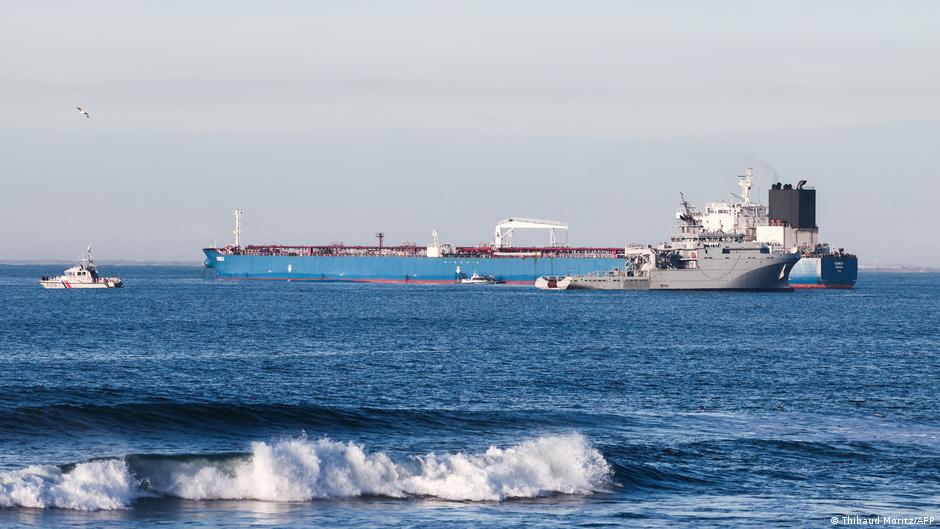
A sanctioned oil tanker associated with Russia’s so-called shadow fleet has issued a distress signal in the North Atlantic, drawing attention to the fragile logistics behind sanctioned oil exports and the potential financial consequences for consumers and everyday investors.
The tanker MYRA sent the alert while sailing off Ireland’s northwestern coast, the maritime monitoring project SeaNews reported on Saturday, Oct. 24. The distress signal was transmitted through the Inmarsat-C satellite communications system, while the United Kingdom Coastguard was coordinating the response.
The vessel is subject to sanctions imposed by the United States, the European Union and the United Kingdom. It had departed from the Russian port of Ust-Luga and, despite extreme weather, was continuing to travel at about 9 knots, equivalent to roughly 17 kilometers per hour, according to SeaNews.
At the time of the alert, waves in the area reportedly reached 8.8 meters, with wind gusts of approximately 130 kilometers per hour. The tanker was estimated to be around 348 kilometers from the coast. SeaNews described MYRA as a vessel with a displacement of 75,000 tonnes.
Why a tanker emergency can matter to household finances
A single maritime incident does not automatically change prices at the pump or household energy bills. However, emergencies involving oil tankers can expose the risks embedded in global supply routes, particularly when the vessels involved operate within networks designed to move sanctioned cargoes.
If a tanker is delayed, damaged or removed from service, the immediate effect is concentrated among its owners, operators, insurers and customers. A broader consumer impact would generally require disruptions across multiple ships or routes. If that happened, tighter shipping capacity and higher transport or insurance costs could feed into wholesale oil prices and, eventually, retail fuel costs.
For household budgets, the relevant transmission channel runs from crude oil and freight markets to gasoline, diesel, heating and the cost of transporting goods. Energy-importing countries may also face pressure on their currencies when oil becomes more expensive, while currencies of major energy exporters can sometimes benefit. Exchange-rate movements may then affect the price of imported food, electronics and travel.
For consumers and small investors, the episode is primarily a reminder that oil prices reflect not only production and demand, but also shipping capacity, sanctions and physical risks at sea.
Everyday investors with exposure to energy companies, shipping businesses, commodity funds or broad stock indexes may therefore watch whether the incident remains isolated. The financial significance would depend on factors not yet established in the report, including the tanker’s condition, the cargo aboard, the duration of any interruption and whether the emergency affects other vessels or shipping lanes.
Sanctions and the alleged shadow-fleet network
According to War & Sanctions, a database maintained by the Main Intelligence Directorate of Ukraine’s Defense Ministry, MYRA has been used to export Russian oil and petroleum products to third countries while circumventing sanctions. Ukrainian intelligence links the tanker to Fractal Marine DMCC, a company registered in the United Arab Emirates that it describes as one of the leading operators of Russia’s shadow fleet.
The Ukrainian database says MYRA has repeatedly called at the Russian ports of Ust-Luga and Primorsk. It has also visited ports in Senegal, Turkey, Brazil, Estonia and Denmark.
War & Sanctions records that the United States placed the ship on its sanctions list on July 30, 2025, followed by the European Union on Oct. 24, 2025. Switzerland and Ukraine sanctioned it on Dec. 13, 2025, the United Kingdom on Feb. 24, 2026, and Canada on March 25, 2026.
Ukrainian intelligence further alleges that MYRA forms part of a shipping network controlled by Mohammad Hossein Shamkhani. He is the son of Ali Shamkhani, Iran’s former Supreme National Security Council secretary and an adviser to the country’s supreme leader, who was killed during a joint U.S.-Israeli operation in February 2026.
According to the Ukrainian intelligence assessment, the younger Shamkhani controls a network of tankers, operators and shell companies used to launder money and transport Russian and Iranian oil, including shipments destined for China.
What savers and investors should monitor
The incident alone offers no basis for households to make abrupt changes to savings or investment plans. Its importance lies in whether it develops into a lasting supply disruption or increases scrutiny of sanctioned shipping networks. A stronger enforcement response could raise the cost of moving Russian and Iranian oil, while an uneventful resolution could leave the broader market impact limited.
Consumers can monitor fuel prices and energy bills rather than reacting to movements in a single tanker. Investors may also look for confirmation from oil benchmarks, shipping rates and currency markets before interpreting the emergency as a wider economic event. For diversified long-term portfolios, the episode represents one of many geopolitical and logistical risks that can create short-term volatility without necessarily changing longer-term financial goals.