Russian Pavilion Protest at Venice Biennale Highlights Political Strife Amid Economic Sanctions
Activists' demonstration at Russian pavilion underscores ongoing political tensions impacting Russian economy and household financial stability.
Political Protests at Venice Biennale Reflect Broader Economic and Social Implications for Russian Households
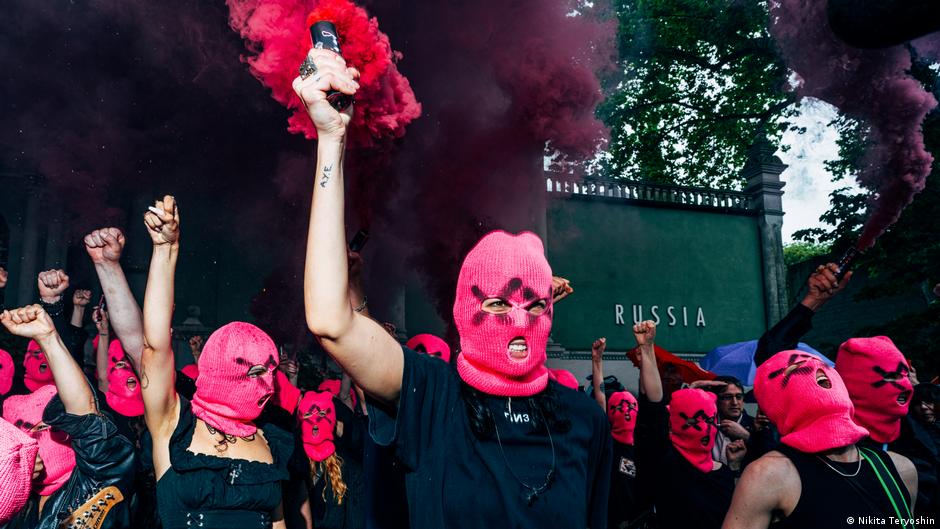
On May 6, members of the feminist punk-rock group Pussy Riot and the Ukrainian women's movement Femen staged a protest outside the Russian pavilion at the Venice Biennale, the world's premier contemporary art exhibition. The activists demanded that Russia be represented by political prisoners holding pro-Ukrainian views instead of state-sanctioned artists. Their demonstration, which included colorful smoke flares and provocative slogans, brought attention not only to the political climate but also indirectly to the economic pressures faced by Russian citizens amid ongoing international sanctions and geopolitical instability.
The protest featured smoke grenades in pink, yellow, and blue, and chants such as "Russian art is blood," highlighting the activists’ claim that the showcased art is overshadowed by the human costs of Russia's military actions in Ukraine. Placards bore messages like "Enjoy the show – ignore the war," "Curated by Putin, corpses included," and "Art on display, graves below," some of which were also painted on protesters’ bodies. Ukrainian flags and masks were hung on statues around the pavilion, further emphasizing the protest’s message.
"Each Russian artwork shown this year stands on an invisible pedestal: Ukrainian blood. You won't find this in the catalog. But it is the only real material that holds this pavilion," stated Femen leader Inna Shevchenko.
The political controversy surrounding Russia's participation in the Venice Biennale comes amid severe economic challenges domestically. International sanctions and diplomatic isolation have heavily impacted Russia’s currency value, inflation rates, and financial markets, all of which affect household budgets and savings. With the Russian ruble experiencing volatility and import restrictions leading to rising prices on consumer goods, ordinary Russians face increased costs for everyday essentials.
Furthermore, the protest comes at a time when Russia's soft power initiatives, such as cultural diplomacy through art exhibitions, are under scrutiny. The European Commission has criticized the organizers for allowing Russia’s participation, citing violations of EU sanctions. In response, the Russian pavilion was open only to invited guests from May 6 to 8, featuring a continuous sound performance titled "Tree Rooted in the Sky." The pavilion closed to the general public on May 9, and Russia was removed from the awards competition, with the jury resigning amid controversy.
The Russian pavilion is managed by Smart Art, a company founded by Ekaterina Vinokurova and Anastasia Karneeva. Karneeva is the daughter of a retired general and deputy director of Rostec, a major state defense conglomerate, while Vinokurova is the daughter of Russia’s Foreign Minister Sergey Lavrov. This close connection to the political elite underscores the intertwining of culture, politics, and economics in Russia’s international representation.
For Russian families, these developments have broader implications. The political tensions reflected in global events like the Venice Biennale contribute to a climate of uncertainty that affects currency stability and investor confidence. With limited access to foreign assets and investment options, many everyday investors and savers in Russia are grappling with how to protect their financial well-being amid ongoing sanctions and economic pressures.
As Russia navigates this complex landscape, the intersection of political protest, cultural representation, and economic realities highlights the tangible impact of geopolitical conflict on household finances and consumer markets. The Venice demonstration serves as a vivid reminder that political and economic spheres remain deeply interconnected, directly influencing ordinary people's lives and their financial futures.