Kyiv Strikes Renew Pressure on Household Security and Daily Costs
Russian overnight attacks on Kyiv followed deadly daytime strikes, adding fresh disruption risks for residents, families and everyday finances.
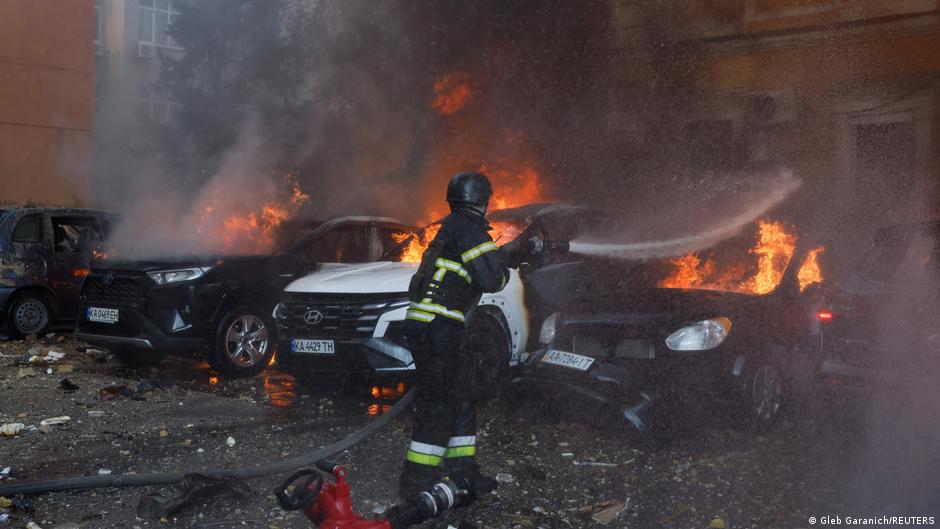
Russian forces again attacked Kyiv overnight into Tuesday, September 29, extending a day of strikes that had already killed two people and injured 26 others in the Ukrainian capital, according to city officials. For households, the renewed barrage adds another layer of uncertainty to daily life: damaged buildings, emergency repairs, transport disruption and the constant financial strain of living under threat.
Kyiv Mayor Vitali Klitschko said debris from a ballistic missile fell in the courtyard of a residential building in the Solomianskyi district. He reported no immediate information about deaths or injuries from the overnight strikes. In the Pecherskyi district, he said, a fire broke out in a three-story non-residential building. Klitschko later clarified that in Solomianskyi district, a fire had also started in one of the buildings of an educational institution after the strike.
“In Solomianskyi district, missile debris fell in the courtyard of a building. There is no fire. In Pecherskyi district, there is a fire in a three-story non-residential building,” Klitschko wrote on Telegram.
The Kyiv City Military Administration also reported that a drone had fallen onto a roadway. Officials additionally said debris caused a fire on the roof of a five-story residential building in the Holosiivskyi district. The overnight attacks followed daytime strikes in central Kyiv on September 28, including strikes on the building of the National Academy of Sciences of Ukraine and the Dobrobut medical center.
Why This Matters for Household Budgets
For residents, the immediate human cost is paramount. But attacks on residential courtyards, roads, educational facilities, medical centers and public buildings also carry financial consequences that can ripple through ordinary household budgets. Even when no casualties are reported in a particular strike, families may face costs linked to broken windows, temporary relocation, transport delays, lost working hours, medical needs, disrupted childcare and repairs to homes or nearby infrastructure.
Such disruptions are particularly difficult for people living on fixed salaries, pensions or limited savings. A missile fragment landing in a residential courtyard can turn a normal monthly budget into an emergency budget overnight. Families may need to pay for taxis when roads are blocked, replace damaged property, buy supplies after power or heating interruptions, or cover medical consultations even when injuries are not life-threatening.
The fall of a drone onto a roadway also points to a broader everyday risk: the cost of mobility. Road closures, emergency services activity and public transport interruptions can make commuting less predictable. For workers paid hourly, freelancers and small business owners, missing even part of a workday can mean lost income. Parents may have to rearrange school runs, while caregivers may face added costs getting relatives to clinics or pharmacies.
Public Buildings, Private Financial Stress
The daytime strikes were especially severe. Klitschko said that from the beginning of September 28, two people were killed in Kyiv and 26 were injured. Eight of the injured required hospitalization, and one was in serious condition. Both people killed were victims of a drone strike on the building of the National Academy of Sciences of Ukraine. The attack caused a major fire, trapped people inside and forced many to escape through windows.
Another Russian strike hit the Dobrobut medical center. Damage to a medical facility has direct implications for access to care, but it can also create financial pressure for patients who must reschedule appointments, travel farther for treatment or seek alternative care. In a city already managing wartime risks, every hit to health infrastructure can push more costs and uncertainty onto households.
Educational facilities and scientific institutions are also part of the household economy, even when they are not businesses in the ordinary sense. When campuses, research buildings or nearby public infrastructure are damaged, staff, students and families can face disruptions to work and study routines. These disruptions may not always appear as a single large bill, but they can accumulate through lost time, substitute arrangements and stress-related expenses.
Everyday Investors Face a Familiar Wartime Risk
For everyday investors and savers, the renewed strikes underline the non-market risks that can affect household financial planning in wartime. The source information does not report currency movements, bank measures or market reactions tied to these attacks. Still, the pattern of repeated strikes on a major capital city is the kind of development that households watch closely when deciding how much cash to keep accessible, whether to delay purchases, how to manage savings and how to think about emergency funds.
In practical terms, families facing repeated attacks often prioritize liquidity: money that can be used quickly for repairs, transport, medicine, relocation or other urgent needs. That can change consumer behavior, reducing spending on non-essential items and shifting attention toward necessities. Small businesses may also become more cautious, especially if staff cannot reliably commute or customers avoid affected areas.
The latest overnight attack did not produce immediate reports of deaths or injuries, according to the information provided by Kyiv authorities. But it came after a deadly day in the capital, and its targets and debris sites were close enough to residential and civilian life to deepen the financial anxiety already carried by many households.
For Kyiv residents, the money story is inseparable from the security story. A strike on a courtyard, a roadway, a roof, an educational building or a medical center can quickly become a family finance event. It affects where people sleep, how they get to work, whether they can access care, how much they keep in reserve and how confidently they can plan even a few days ahead.



