EU to Fund Ukraine Drone and Missile Purchases as Budget Talks Loom
The new support package comes as European leaders prepare to debate Ukraine’s financing needs and wider international backing for the year ahead.
The European Union is preparing to provide additional financing to Kyiv in mid-October for the purchase of drones and missiles, a move that places Ukraine’s defense needs back at the center of Europe’s political and budget agenda. For households and everyday investors, the decision is not only a foreign-policy development. It is also part of a broader fiscal picture that can affect government budgets, currency sentiment, energy security and market expectations across Europe.
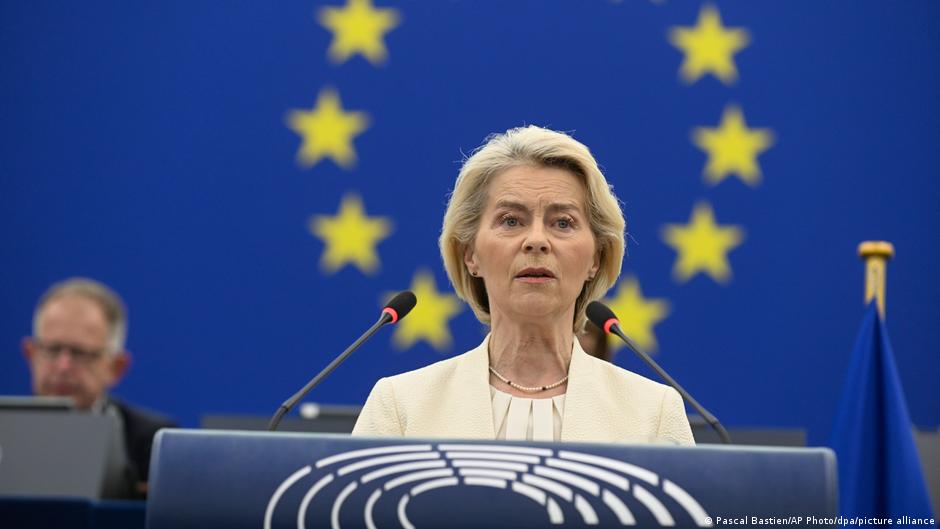
European Commission President Ursula von der Leyen announced the planned funding on Sunday, October 11, in a post on X after a phone call with Ukrainian President Volodymyr Zelensky. She said the money would be used to strengthen Ukraine’s defense and protect its airspace, though she did not specify the size of the new financing or identify the sources from which it would be drawn.
“This is necessary to strengthen Ukraine’s defense and protect its airspace,” von der Leyen said.
The lack of a disclosed figure matters for investors and taxpayers because the cost and structure of Ukraine-related support have become recurring questions for European governments. Any new allocation may feed into debates over public spending, borrowing priorities and the trade-offs facing national budgets at a time when many households remain sensitive to energy costs, food prices and interest rates.
Why the Funding Decision Matters for Household Budgets
Brussels said the situation in Ukraine will be one of the central topics at this week’s European Council meeting. Leaders are expected to discuss financing needs for the coming year and ways to mobilize new international support. That makes the latest drone and missile funding part of a larger conversation about how Europe intends to sustain assistance to Ukraine while managing its own fiscal pressures.
For consumers, the link is indirect but significant. Defense and reconstruction support can influence national budget choices, especially if governments must decide whether to redirect existing funds, raise debt issuance or seek new collective financing tools. These choices can shape the policy environment in which taxes, public services and inflation-fighting measures are debated.
Currency markets may also watch the discussions closely. While the source article does not provide market reaction or forecasts, support for Ukraine is tied to broader perceptions of European political unity and fiscal capacity. Investors often assess whether the EU can maintain coordinated action during prolonged geopolitical stress. A clear funding path can reassure markets about policy continuity, while uncertainty over sources of financing can add another layer of caution.
The announcement also comes against the backdrop of ongoing concern over energy infrastructure and food supplies. Von der Leyen said she fully supported Zelensky’s call for a ceasefire that would protect global food supplies and energy infrastructure in Ukraine and Russia. Those areas are directly relevant to household budgets because disruptions in energy and agricultural supply chains can affect utility bills, transport costs and grocery prices.
Ukraine Facility Adds Longer-Term Financial Context
The new mid-October funding plan follows an earlier European Commission decision on October 2 to approve a 2.9 billion euro tranche for Kyiv under the Ukraine Facility. That mechanism was created to provide long-term financial assistance to Ukraine and is designed to run from 2024 through 2027.
Under the Ukraine Facility, the EU has said it can provide Ukraine with up to 50 billion euros in stable and predictable financial support over that period. The payments are linked closely to Ukraine’s implementation of a specific plan for recovery and reforms, as well as support for democratic mechanisms, the rule of law and human rights. According to the Commission, payments are made quarterly after verification that the conditions for receiving them have been met.
For savers and retail investors, the structure of the Ukraine Facility is important because it signals that EU support is not limited to one-off emergency transfers. Instead, it is being framed as a multi-year financial commitment with conditions attached. That kind of predictable financing can reduce uncertainty for Ukraine’s public finances, but it also means the EU’s own budget discussions will continue to include Ukraine-related obligations through 2027.
The latest announcement also intersects with Ukraine’s path toward the EU. Von der Leyen said two new clusters of topics in Ukraine’s EU negotiation process would be unlocked. While the source did not specify which clusters, the move indicates that financial, political and accession-related discussions are advancing in parallel.
A Darker Phase of the War, and a Longer Fiscal Horizon
Von der Leyen described the war as having entered a new and even darker phase. She said Russia is waging a war of attrition on the battlefield and striking civilians far beyond the front line. That assessment helps explain why drones, missiles and air defense are being highlighted as immediate priorities.
For households, the practical question is how long this environment of elevated security spending and geopolitical risk will last. The source article makes clear that EU leaders are already looking ahead to financing needs for the coming year, while the Ukraine Facility extends the financial framework through 2027. That longer horizon suggests that Ukraine-related support will remain part of the economic backdrop for consumers, savers and investors for some time.
Everyday investors may therefore read the upcoming European Council meeting as more than a diplomatic event. It is a signal point for how the EU plans to balance military assistance, reconstruction funding, accession talks and domestic budget pressures. The specific amount of the new drone and missile financing has not yet been disclosed, but the direction of travel is clear: Brussels is preparing additional support while seeking broader international backing.
For now, the immediate facts are limited but consequential. The EU plans to allocate extra funding in mid-October for Ukraine to buy drones and missiles. European leaders will debate Ukraine’s financing needs and new international support this week. A separate 2.9 billion euro tranche has already been approved under a facility that can provide up to 50 billion euros through 2027. For consumers watching bills, savings and currencies, those decisions belong to the same financial story: the war in Ukraine continues to shape Europe’s economic priorities as well as its security policy.